


Hi there,
Welcome to the first issue of runmyaibiz.
Scroll any business feed this month and you’ll see people bragging about their AI tools. “I built an app in an afternoon with Lovable.” “Claude Code wrote my whole site.” “Bolt, Replit, Base44, Manus...” The excitement is real, and some of it is well deserved.
But here’s what almost nobody says out loud: an app is not a business. A business needs a product and a sales page and a funnel and lead magnets and bonuses and someone to keep it all running. Most people answer that by stacking up more tools.
There’s a simpler way: one AI that does it all. You talk to it, it does the heavy lifting, and you approve every step. By the end of this issue, I think you’ll see why one system beats owning all the others at once.
First, a little history, because it explains everything.
1. The Evolution Files: AI didn’t arrive in 2022
You’ve been using artificial intelligence for years. Here’s the short version of how we got here:
1950: The question. Alan Turing opened his paper Computing Machinery and Intelligence with “Can machines think?” (Turing, Mind, 1950, PDF)
1997: The headline. IBM’s Deep Blue became the first computer to defeat a reigning world chess champion, Garry Kasparov, in a match under standard tournament controls. (IBM)
2015: AI inside Google Search. Google confirmed that a machine-learning system called RankBrain was helping interpret “a very large fraction” of searches and had become its third-most important ranking signal. (Bloomberg; Search Engine Land)
Your inbox, all along. Google says Gmail’s machine-learning models, together with its other protections, block more than 99.9% of spam, phishing and malware. (Google Workspace Blog)
2018: AI finishing your sentences. Gmail’s Smart Compose used neural networks to suggest the rest of your sentence as you typed. (Google Research)
2022: Everyone could talk to it. ChatGPT launched at the end of November 2022. UBS estimated it reached 100 million monthly users in about two months, which made it the fastest-growing consumer app on record at the time. (Reuters)
2024–2026: AI started building. A wave of tools appeared that turn a sentence into a working app. People call it “vibe coding.” Lovable reports that 80% of the people building on its platform are in self-identified non-technical roles. (Lovable report, June 2026)
What this means for you: AI went from answering to acting. It can now plan, write, design and build. That’s the shift that makes a real online business possible for one person with an idea. The question is no longer “Can AI help?” It’s “How many tools do I really need?”
2. Bragging Rights: Lovable
What it is: You describe an app or website in plain English and Lovable builds it, with hosting and a built-in backend.
Why people rave about it:
It’s built for non-coders. In Lovable’s own data, 80% of builders are in non-technical roles, and over half of surveyed users say they’re building a business. (Lovable)
It’s growing fast. TechCrunch reported Lovable’s annualized revenue crossed $600M in September 2026. (TechCrunch)
The free plan lets you try it. You get 5 build credits a day, up to 30 a month. Pro starts at $25/month for 100 credits. (Lovable plans)
What it still leaves you doing: Lovable is genuinely great at building the app or site. To turn that into a business, you still have to:
Connect the plumbing yourself. Payments and email come through integrations you set up, such as your own Stripe account, or Resend for email with API keys you add as secrets. (Lovable + Stripe; Resend + Lovable)
Create the offer: what you sell, why it’s worth it, and the sales page copy.
Build the lead magnet and bonuses that get people interested.
Write and run the follow-up emails, plus the day-to-day of your business.
Watch your credits, because building, chatting, hosting and in-app AI all draw from one balance. (Lovable credits)
None of that is a knock on Lovable. It’s simply a different job. Lovable builds software. You’re trying to build a business.
3. The One AI That Does It All
Here’s the idea this newsletter is built around, and I’m going to make the case for it every week.
Picture how most people build today:
brainstorming in ChatGPT
researching in Perplexity
writing in Claude
building the site in Lovable or Bolt
making slides or graphics somewhere else
then copying, pasting and stitching it all together.
That’s the same old grind, just with shinier tools.
Now picture one AI you simply talk to:
You describe your idea in a normal conversation.
It helps create the product, write the sales page, set up the funnel, and build your lead magnets and bonuses.
It works on its own computer, with its own browser. You don’t install anything or open a terminal.
It also handles the running: email, scheduling and routines.
Nothing goes live without your approval. Don’t love the headline? Send it back. Want a stronger offer? Ask for one. You’re the owner; it does the heavy lifting.
Why one beats all of them at once:
One conversation holds the whole picture. Your product, your sales page and your emails come from the same understanding of your business. You stop re-explaining yourself to five different tools.
No copy-paste glue. The work doesn’t get lost or garbled between apps.
One place to approve. You review and approve each step in one place, not across five dashboards.
It covers building and running. Most of the tools people brag about stop at “built.” A business keeps going after launch.
One relationship instead of a stack of meters (see the math below).
4. The Hard Way vs. the Easy Way: Meet the three entrepreneurs behind the mastermind
Everything in this newsletter points at one idea: one AI that does it all. So you deserve to know who showed me what that looks like in practice.
They’re three entrepreneurs who built their fortunes online the hard way, over decades. One has earned over $140 million online. The other two have earned several million each.
The hard way meant years of selling online the way everyone did: piecing together the tools, the help and the hours a business needed, one launch at a time. If you’ve ever tried to launch something online and found it was too much to do alone, they’ve lived the long version of that.
You don’t need an inside story to see the point: decades of doing it the hard way, then a deliberate switch to doing it with one AI.
The easy way is why they teamed up. They wanted to show people what they now do with one AI:
Two of them run all of their online businesses with it.
The third uses it to manage his existing businesses, and to launch and run new ones.
That’s what makes the idea real for me. These aren’t people experimenting with a shiny tool on the side. They’re people with decades of experience who chose to run their businesses with one AI.
If you’re curious, the mastermind at runmyaibusiness.com shows how they use it, with live presentations and example businesses.
Their results are not typical. They reflect decades of experience selling online; most people who try to earn online make little or no money, and your results depend on your effort, skills, and market.
(If you join through my link, I earn a commission.)
5. The Patchwork Math
Here’s what a typical tool stack costs at current published prices, for the monthly plans most people start with:
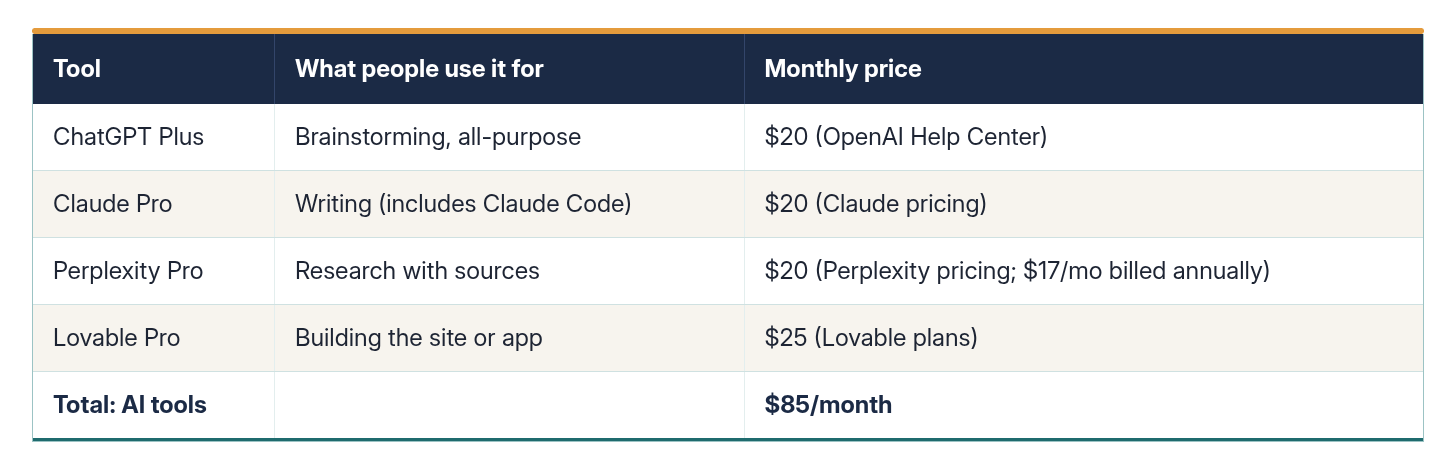
Sources: OpenAI Help Center; Claude pricing; Perplexity pricing; Lovable plans
And that’s before the business basics. Add an email platform with automations (Kit Creator, $39/mo for up to 1,000 subscribers; Kit billing), basic hosting (Hostinger Premium, $2.49/mo on a 48-month prepaid term; Hostinger) and card processing (Stripe, 2.9% + 30¢ per sale; Stripe). That comes to about $126.50/month, plus fees on every sale.
Prices checked October 20, 2026. Hostinger’s rate is promotional and requires prepaying; renewals are higher. Prices change, so check each vendor before you buy.
The money is only half of it. The bigger cost is you acting as the glue between them every day.
6. Quick-Start Idea: Turn what you already know into a simple guide
The idea: a short, practical digital guide or checklist (10–20 pages) on one skill or problem you already know well: landing freelance clients, growing a social media account, writing a résumé that gets callbacks, using a piece of software at work, or a craft you’ve practiced for years. Whether you’re just starting out or have decades of experience, you know something a beginner would pay to learn faster.
With one AI: in a single conversation it can help outline the guide, draft each section in your voice, write the sales page, create a free checklist as a lead magnet, and suggest a bonus. You approve each piece.
Your first step this week: write down three things friends, coworkers, clients or people online have asked for your help with. That’s it.
7. Your Move
Reply with one sentence: what business have you always wanted to build? Or, if you tried before, what stopped you? I read every reply, and your answers shape upcoming issues.
Next week: Claude Code, the tool developers can’t stop talking about. What it’s brilliant at, what it needs from you, and why “conversation, not code” matters if you’re not a programmer.
Your dream didn’t expire. The tools finally caught up.
Jacqui
runmyaibiz.com
My goal is to educate you on the all-in-one AI that can help you launch and run an entire online business in one place. Want to see it in action? Learn about the mastermind at runmyaibusiness.com. In it, three entrepreneurs who built their fortunes online the hard way (one has earned over $140 million, and the other two several million each) teamed up to show you the easy way. Two of them now run all their online businesses with this one AI, and the third uses it to manage his existing businesses and to launch and run new ones. They show how they use it, with live presentations and example businesses. (If you join through my link, I earn a commission.)
Their results are not typical. They reflect decades of experience selling online; most people who try to earn online make little or no money, and your results depend on your effort, skills, and market.
Not a paid member yet? Every full issue, deep-dive walkthrough and tool comparison is $9/month.
For educational purposes. No income or results are promised; outcomes depend on your effort, skills, and market. Product names belong to their owners; prices were checked October 2026 and may change.